

It has been a very interesting two days, with a great deal of news and, thankfully, almost no military developments. The news over the past two days has been dominated by political and strategic developments. At the same time, new details have emerged about the war and the events surrounding it.
There are a few other important stories that I will cover tomorrow. For now, however, I wanted to make sure I reported on the events I witnessed firsthand while they were still fresh in my mind.
Yesterday, I took part in two interesting events. The first was the Herzliya Conference on Diplomacy and Security, an annual event that I have attended for many years. The second, which caused me to leave the Herzliya Conference early, was the official launch of Yashar, Gadi Eisenkot’s party
Amid all of this, Prime Minister Netanyahu gave an interview on Channel 14 News—his home channel—where he made news mostly because of the lies he told, but also because of some of his strange statements.
We’ll begin with Prime Minister Netanyahu because that’s the easiest place to start. Beyond making all sorts of broad-sweeping election claims with no basis in fact, Netanyahu made three statements that stood out. The first was unforgivably tone-deaf. When asked how he had changed since October 7, his answer was, “I lost some weight.” There was no comment on the thousands who have died. There was no reflection on the hostages, and absolutely no acknowledgment of the trauma the country has endured—just, “I lost some weight.”
The inexcusable second Netanyahu remark was an outright falsehood. He claimed that before Israel’s attack on Iran, Iran already had nuclear weapons—actual nuclear bombs. That is simply untrue. Did Iran have a robust nuclear program? Of course. Did it possess nuclear bombs? Absolutely not. There is no factual basis for that claim.
Perhaps the saddest answer Netanyahu offered came when he was asked whether the war was over and whether Israel had achieved “total victory.” His response was that the war will never end and that we simply have to remain strong. A forever war? Is that really what most Israelis want?
Lastly, Netanyahu repeated his familiar argument that anyone—other than him—would lead Israel toward the establishment of a Palestinian state. He and his spokespeople continue to claim that Gadi Eisenkot supports a Palestinian state. Today, one of Likud’s loyalists, Moshe Sa’ada, appeared on a morning radio I listen to.
Throughout the interview, Sa’ada repeatedly insisted that “the left-winger” Gadi Eisenkot had called for the establishment of a Palestinian state. The experienced interviewers pushed back forcefully, asking, “Where? Show us one instance where Eisenkot said that.” Saada could not provide a single example. Instead, he replied, “Interview him. Ask him the question. I’m sure it’s true.”
The reality, of course, is that Eisenkot has never, ever called for the establishment of a Palestinian state. He has a different vision for Israel’s future than Netanyahu, but it certainly does not include the establishment of a Palestinian state, at least not anytime in my lifetime.
HERZLIYA CONFERENCE
The Herzliya Conference is held every year at Reichman University, formerly known as the Interdisciplinary Center (IDC) Herzliya. The conference brings together leading security experts from both inside and outside the government. This year, there were fewer representatives from the government and many more opposition figures, academics, and former senior military officials who spoke or participated in panel discussions.
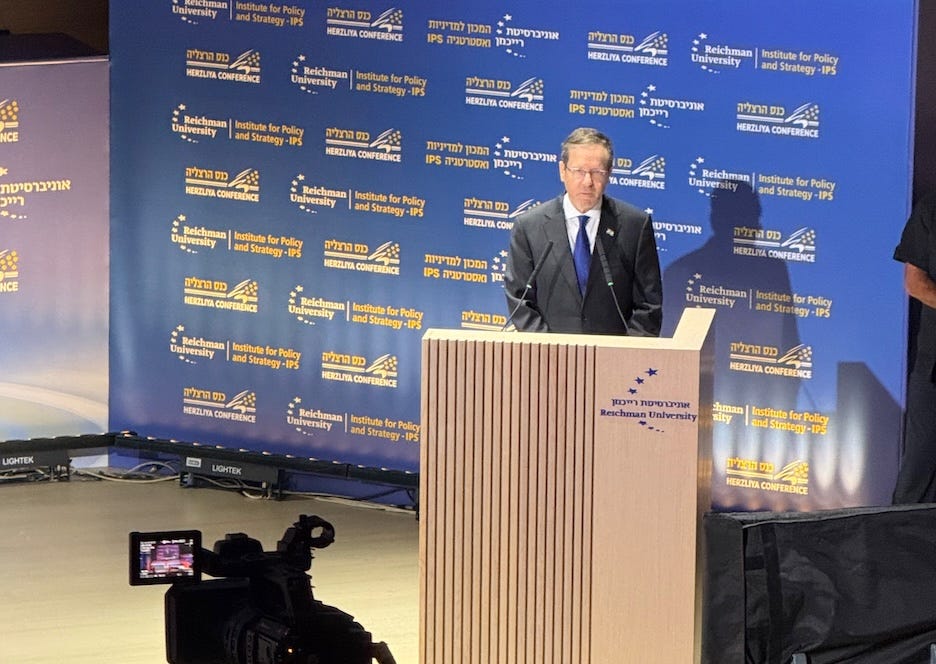
President Isaac Herzog delivered the keynote address at the opening session yesterday, along with U.S. Ambassador to Israel, Mike Huckabee. Herzog’s most notable message was that Israel is at one of the most critical moments in its history. He warned that societies do not fall apart in a single day, but rather through a gradual process. Moreover, Herzog observed that nearly every group in Israeli society believes it is a persecuted minority.
Ambassador Huckabee, in contrast, brought a lighter tone to the conference. He was humorous and told several entertaining stories. At the same time, the Ambassador emphasized that Christianity owes its foundations to Judaism and its roots in the Land of Israel. He clearly comes from the tradition of American Christians who view the Holy Land and Israel as central to their own faith. It is an interesting perspective for the United States ambassador to Israel to bring to the role.
One of the early speakers was Matanyahu Englman, the outgoing State Comptroller. Englman had just been told by the Supreme Court of Israel that he could not continue his investigations into the events of October 7, because he lacked the legal authority to do so, and he was repeatedly pressed on that issue
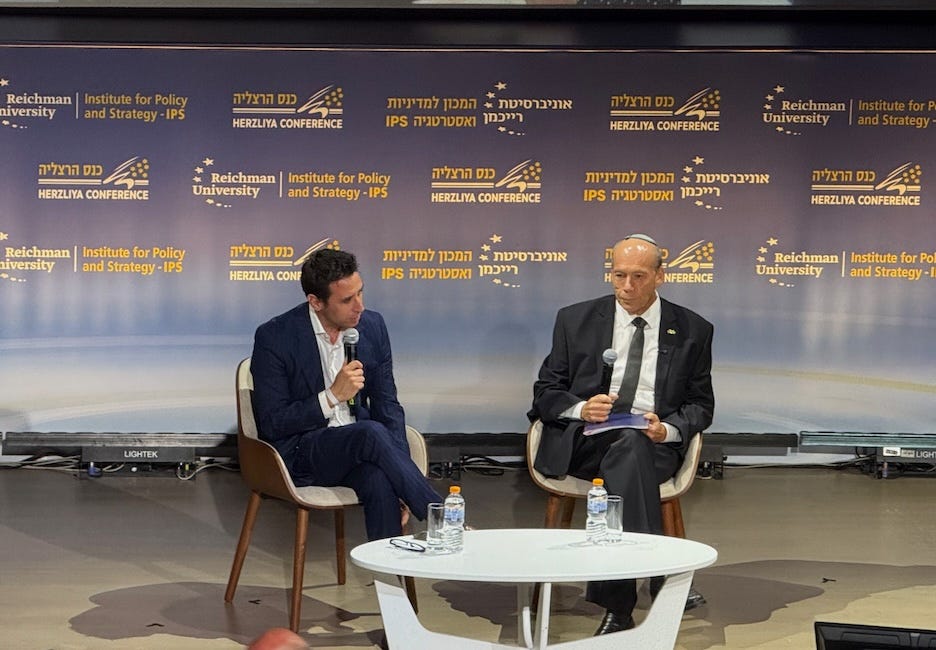
.
The only time I heard booing during the conference was when Englman stated he refused to call for a National Commission of Inquiry. Despite being challenged in a variety of ways, he supported numerous other forms of investigation but would not endorse the one inquiry that much of the country has been demanding.
Englman was originally known as a close ally of Prime Minister Netanyahu. It is no longer entirely clear where he stands politically, nevertheless, he refused to cross that line, even though his term as State Comptroller was, in theory, set to end at midnight last night. That departure has since been delayed by the Supreme Court, which is reviewing the Knesset’s vote to appoint his successor. According to the petition before the court, the appointment process did not follow the required procedures and may have violated the law governing the selection of the State Comptroller.
The most important point Englman made was that no one in Israel is willing to accept constructive criticism and act on it. Over the past three years, Englman has issued numerous reports highlighting serious governmental failures, yet not a single senior official has resigned as a result. In fact, as far as I know, the cabinet has never even held a meeting to discuss any of the reports he submitted.
The next session was the first to focus on the conference’s central question. The panel included former Israel Air Force Commander Amikam Norkin, former National Security Adviser Tzachi Hanegbi, former Mossad director Tamir Pardo, and David Makovsky of the Washington Institute for Near East Policy. The central question in this session, and in several others throughout the conference, was whether Israel is better off now, nearly 1,000 days after the war began.
The answer was remarkably consistent. Nearly everyone agreed that Israel is in a much stronger tactical and military position than it was at the outset of the war. Strategically, however, they argued that Israel’s position has rarely been worse, both in the Middle East and internationally

.
Much of that assessment centered on the second conflict with Iran. The view expressed was that Israel had effectively used its military option without achieving its strategic objectives, leaving Iran far less concerned about the possibility of future Israeli military action. Former Air Force Commander Norkin argued that additional military strikes against Iran would accomplish little, leaving Israel in an extremely difficult strategic position.
That concern becomes even more serious when viewed alongside political developments in the United States. David Makovsky, whose analysis has often proven accurate, outlined a scenario that I have long feared. He argued that if the Democrats return to power—which he believes is a distinct possibility—there could be growing pressure not to end U.S. military aid to Israel, but to halt future arms sales.
In Makovsky’s view, the progressive wing of the Democratic Party is becoming increasingly influential, with some members questioning Israel’s very legitimacy. That is a deeply troubling possibility and one that cannot be dismissed. That trend was further underscored by Tuesday night’s Democratic primary in Colorado, where a long-serving pro-Israel congresswoman was defeated by a Democratic Socialist challenger after Israel and Palestine became defining issues in the campaign.
Hanegbi, who headed Israel’s National Security Council when the war began, acknowledged that some losses can never be reversed. Israel will never bring back those who were killed, restore the health of the thousands who were wounded, or fully recover the international support it once enjoyed in many parts of the world. Tamir Pardo concluded by arguing that military force alone never resolves a conflict. Echoing the well-known principle that war is merely the continuation of politics by other means, he argued that this government has failed to translate military operations into effective political strategy.
In addition to the notable speakers I mentioned above, there was a considerable amount of news from the Herzliya Conference today. Among the most notable speakers was Maj. Gen. (Res.) Nitzan Alon, who led Israel’s efforts on the hostage issue for much of the war. Alon stated unequivocally that Israel had not achieved “total victory.”
More importantly, Alon argued that there was no reason the war in Gaza could not have ended a year earlier. Had it done so, he said, fewer Israeli soldiers would have been killed and more hostages would have returned alive. Although he did not say so explicitly, it is also clear that Israel’s international standing would likely have been far stronger had the war ended sooner.
The leaders of all the major political opposition parties also addressed the conference, and their presentations were generally strong. When Gadi Eisenkot was pressed about his positions during the war, he revealed an interesting detail. He said that shortly after the first hostage agreement, and knowing about the pager operation as well as a broader military plan that he did not disclose, he urged Prime Minister Netanyahu to seize the initiative and launch a surprise offensive against Hezbollah in Lebanon. According to Eisenkot, Netanyahu rejected the proposal.
Naftali Bennett made headlines when he argued that after Prime Minister Netanyahu persuaded President Donald Trump to withdraw from the Joint Comprehensive Plan of Action (JCPOA), Israel failed to prepare for the possibility of a future war with Iran. Bennett said that when he became prime minister, he immediately convened an emergency meeting with the heads of Israel’s defense industries to determine the country’s readiness. According to Bennett, they told him that the necessary weapons existed but had never been ordered.
Bennett did not specify which systems they were referring to, although I believe one of them was Israel’s long-range stand-off air-launched missile. Furthermore, Bennett said that his government had begun developing a program designed to prevent Iran from shutting down internet access during a future conflict. He maintained that the technology was feasible but that Netanyahu canceled the project after returning to office.
Lastly, Bennett also emphasized Israel’s growing international isolation, arguing that the country’s foreign policy has been largely neglected. He said that under a new government, restoring Israel’s diplomatic standing would become a priority.
Avigdor Lieberman focused on Netanyahu’s decision-making process, arguing that the prime minister increasingly governs alone, without a functioning cabinet or senior advisers willing to challenge him when he makes mistakes. Lieberman painted a bleak picture of Israel’s current strategic position and predicted that the next election could produce a surprise similar to Hungary’s recent political upheavals.
The final opposition party candidate to speak was Yair Golan. His central message was that Israel must first put its own house in order. He described the war with Iran as a failed campaign and warned that Iran would almost certainly seek revenge in the future. When pressed about the Palestinian issue, Golan argued that the real question is not whether there will be a Palestinian state, but whether Israelis are prepared to live in a single state together with the Palestinians.
Former Chief Judge Aaron Barak appeared at the conference and was interviewed by the conference organizer Maj. Gen. (Res.) Prof. Amos Gilead. He was crystal clear in his views and started by echoing some of Lieberman’s statement about one-man rule:
Democracy in danger. We’re in a democracy that is moving away from being democratic. A democracy where it’s not clear that we are citizens. The situation just didn’t begin today. There are no checks and balances in Israel. The need for checks and balances are clearer now than ever. I remember that Begin had told me, if you remember, I was a the legal advisor to the government in the time in Rabin’s time also during Begin’s time. Begin used to say that, what does it mean that the Prime Minister is number one?
According to Begin, the Cabinet Minister is thinking of him as one, but he thinks of them as equal. That’s not the case now. No one thinks there’s any equivalence between the Cabinet members and the Prime Minister. The Prime Minister is totally in charge. Who can stop the government?
The answer is that only the courts can do it. That is why the judiciary has become the target of efforts to completely change it—specifically, to change the composition of the committee that selects judges so that “our” judges will be appointed instead.
This process actually began under Ayelet Shaked, and now it is continuing in full force under Yariv Levin. The law has already been changed. It has been passed, although, by a stroke of luck, it will only take effect after the elections. But the change itself has already been made. Under the new system, politicians—and only politicians—will choose the country’s judges.
So, ladies and gentlemen, we are in trouble. I’ve heard a great deal about our security challenges, but we are also facing profound social and legal challenges, and the two are interconnected.
Avigdor Lieberman made the point here a few minutes ago: who advises the prime minister? Who is able to tell him “no”? The answer is that there is effectively no one. That is an extremely serious constitutional problem. It is a serious social problem, a serious legal problem, and ultimately a serious security problem as well. That is why your cause is so important.
Therefore, we must bring about change. People keep asking me, “Are you optimistic?” And I say yes—I am an optimist by nature. “How can you possibly be optimistic?” Because I see light at the end of the tunnel. And what is that light? Elections. That is what gives me optimism. Nothing else. That’s it. Thank you.
LAUNCH OF THE YASHAR PARTY
The second part of my evening was spent at the official launch of the Yashar party, led by Gadi Eisenkot. The event took place at a hall outside Hod HaSharon. I wasn’t quite sure what to expect, but I was pleased to receive an invitation, which suggested that I had become one of the more active party supporters. When I arrived, I was surprised to find an elaborate buffet. For the first half hour, people stood together eating, talking, and greeting one another before everyone was invited into the main hall.
As we entered, the music playing was the anthem of the Golani Brigade. Golani is the brigade in which Eisenkot began his military career and remains a central part of his identity. It is one of the IDF’s most celebrated infantry units, having served on the front lines in virtually every major conflict, and Eisenkot eventually rose to command the brigade. Eisenkot went on to become the Chief of Staff of the IDF after serving in many key roles, including commander of the Judea and Samaria Division and Military Secretary to both Ehud Barak and Ariel Sharon.
The atmosphere inside the hall was positively electric. When Gadi Eisenkot walked into the room, there was a palpable sense among those present that the next prime minister of Israel had just entered. Whether that expectation will ultimately be fulfilled remains to be seen, but there was no mistaking the enthusiasm and optimism that filled the room.

Throughout the evening, several people expected to play senior roles in a future government gave presentations. The former head of the Israel Security Agency outlined his vision for the Ministry of National Security. The former head of the Budget Department in the Finance Ministry discussed his economic priorities. Another speaker, Inbar Harush, presented a plan for integrating the ultra-Orthodox into military service, while several others outlined proposals in their respective areas of responsibility.
Finally, it was time for Eisenkot to deliver his inaugural campaign speech. Eisenkot delivered an excellent address. He has clearly considerably honed his public speaking skills since entering politics.
Over the past day, I have now heard remarks made by all of the major candidates. It is not clear to me that Eisenkot would necessarily be the best prime minister among them. Nevertheless, I am convinced of two things. First, Eisenkot would almost certainly be the most honest. Second, and in my view by far the most important, Eisenkot is the candidate most likely to defeat Netanyahu in a general election.
Eisenkot undeniably remains the opposition’s most popular figure, making him a difficult target despite the inevitable attempts to portray him as a “leftist” or worse. That is why I support Gadi Eisenkot. The incontrovertible primary objective is to bring about a change of government. If that happens, I hope that each and every opposition leader will work together to build an effective and successful government.
ISRAELTECH INTERVIEW
As part of our partnership with IsraelTech we bring you the latest interview: “She Left Cyber Money to Bet on Something Bigger,” featuring Yael Barsheshet of Deep33.
Yael Barsheshet, partner at Deep33, spent 11 years as a Major in the 8200 unit of the IDF. When she left, every door in Israeli cyber was open to her. Three founding teams wanted her. The network was there and the choice was obvious.
But Yael said no to all of it. Instead she joined Zebra Medical Vision, an early-stage AI company doing deep learning on medical imaging, because she believed the technology could change how people receive care.
That decision set off a chain that took her through venture investing at Hetz, a semiconductor deal most generalist funds wouldn’t touch, and eventually to Deep33, a new $200 million fund backing Israeli founders building AI infrastructure. The unglamorous, essential layer: compute, memory, energy efficiency, the bottlenecks that determine whether AI actually delivers ROI at scale.
Yael sits in the New York office while her partners Michael Broukhim, Joab Rosenberg, Ori Amsalem, Lior Prosor cover the LA and Tel Aviv offices. During the conversation, Yael shares what 8200 actually teaches you, why deep tech in Israel is hitting its moment now, and what it looks like to build a thesis around the parts of the AI stack nobody wants to explain at a dinner party.
You can watch the full interview here, or check out a brief excerpt below.
BUSINESS
Element Labs
Israeli AI chip startup Element Labs has raised an additional $300 million to $400 million from existing investors, including Fidelity, at a valuation exceeding $4 billion, according to reports. The company, founded in 2024 by semiconductor veteran Avigdor Willenz יחד with former Habana Labs executives Ran Halutz and David Dahan, has remained almost entirely out of the public eye despite becoming one of Israel’s most valuable private technology companies. Element Labs reportedly employs about 350 people in Caesarea and Tel Aviv while maintaining an unusually low profile, with no public website or LinkedIn presence and relying primarily on employee referrals for recruitment.
Element Labs is targeting one of the fastest-growing segments of artificial intelligence infrastructure: inference, the stage where trained AI models generate responses and perform tasks. Rather than competing directly with NVIDIA’s GPUs in training large language models, the company is developing specialized AI processors, networking technology, and software designed to reduce the cost and power consumption of running AI workloads at scale. Its technology is aimed at hyperscale cloud providers, AI model developers, and next-generation cloud infrastructure companies seeking more efficient alternatives for deploying AI services.
The company’s founding team brings one of the strongest track records in Israel’s semiconductor industry. Willenz previously built and sold Galileo Technology, Annapurna Labs, and Habana Labs in multi-billion-dollar acquisitions by Marvell, Amazon, and Intel, respectively. Industry observers believe those relationships have helped Element Labs gain access to leading semiconductor manufacturers and major cloud providers. The latest financing follows another major investment in Willenz’s portfolio, with Xsight Labs recently raising approximately $300 million at a $3 billion valuation, underscoring continued investor confidence in Israeli companies developing AI infrastructure technologies.
Baz
Israeli AI software startup Baz has raised an additional $9 million in seed funding, bringing its total financing to $17 million, as it expands its platform for managing AI-assisted software development. The extension round was co-led by existing investors Battery Ventures and boldstart ventures, with new investors AFG Partners and Disruptive VC joining the company. The new capital will be used to accelerate research and development of AI coding agents for enterprise engineering teams.
Alongside the funding, Baz unveiled Baz Planner, a new product that analyzes software development plans before coding begins. Rather than reviewing completed code, the platform evaluates proposed changes, identifies potential bugs and security vulnerabilities, and modifies development plans to prevent problems from reaching production. The company says the approach reflects the growing need for governance as enterprises increasingly rely on AI-generated code. Baz currently serves more than 100 customers in the AI, infrastructure, and cybersecurity sectors.
Baz was founded by Guy Eisenkot and Nimrod Kor, veterans of the team behind Bridgecrew, the Israeli cloud security startup acquired by Palo Alto Networks for $200 million in 2021. Eisenkot later led application security initiatives at Palo Alto before launching Baz in 2023. The startup’s early development coincided with the outbreak of the Gaza war, during which both founders served extended reserve duty, a period that Eisenkot has described as shaping the company’s mission and resilience.
Root
Belgian cybersecurity unicorn Aikido Security has acquired Israeli startup Root in a deal estimated at between $70 million and $100 million, strengthening its position in the fast-growing AI-powered application security market. As part of the acquisition, Aikido will establish a new development center in Israel, retaining Root’s entire local workforce and planning additional hiring. The acquisition follows Aikido’s recent purchases of several AI security companies and comes shortly after the company raised a $60 million Series B round at a $1 billion valuation.
Root, formerly known as Slim.AI, develops AI technology that automatically patches vulnerabilities in open-source software without requiring customers to upgrade applications or migrate to new platforms. Founded by Benji Kalman, Mickey Gordon, Ian Riopel, and John Amaral, the company employs about 25 people, including roughly 15 in Tel Aviv, and has raised approximately $31 million from investors such as Insight Partners, Decibel Ventures, Boldstart Ventures, Lema Partners, and TechAviv. Its customer base includes SiXworks, DeleteMe, and Relay Networks.
The acquisition reflects continued consolidation in the cybersecurity sector as companies race to integrate AI into software security. Both companies said the goal is to automate the remediation of software vulnerabilities rather than simply identify them, allowing organizations to secure existing applications more quickly while avoiding disruptive upgrades or code changes.
Arato
Israeli AI testing startup Arato has raised $10 million in seed funding to expand its platform for validating enterprise AI systems before and after deployment. The financing round was led by TLV Partners with participation from Jibe Ventures, Andreessen Horowitz partner and former VMware CEO Raghu Raghuram, and former Intuit CTO Marianna Tessel. Founded in 2024, the company employs 23 people, all based in Israel.
Arato has developed an AI assurance platform that evaluates enterprise AI applications by generating tens of thousands of simulated user interactions. Rather than requiring access to source code or complex integrations, the platform tests AI systems through their existing interfaces using text, voice, image, and business data inputs. It then analyzes the results to identify recurring errors, operational risks, and performance weaknesses, providing product and engineering teams with data-driven insights into the reliability, security, regulatory compliance, and overall readiness of AI applications for production use.
The company was founded by CEO Shahar Erez, CTO Hilik Paz, and VP of R&D Tal Salmona, who previously worked together at Mercury and VMware developing software testing, application monitoring, and cloud infrastructure tools. Erez and Paz also co-founded workforce management startup Stoke, which was acquired by Fiverr in 2021 for $95 million. Arato is positioning itself to address the growing need for enterprise AI quality assurance as organizations increasingly deploy mission-critical AI systems that require consistent, measurable performance beyond traditional software testing.