
JUNE 14, 2026: U.S. and Iran Reach Agreement, as Israel Fears Its Key Interests Have Been Overlooked
Tel Aviv Diary

As I was about to push “publish” on tonight’s Tel Aviv Diary, the Prime Minister of Pakistan announced that the United States and Iran had reached an agreement and that it would be formally signed in Switzerland on Friday.
Following the Pakistani Prime Minister’s statement, President Trump followed up by posting:
The Deal with the Islamic Republic of Iran is now complete. Congratulations to all! I hereby fully authorize the toll free opening of the Strait of Hormuz, and, simultaneously herewith, authorize the immediate removal of the United States Naval blockade. Ships of the World, start your engines. Let the oil flow! PRESIDENT DONALD J. TRUMP
No official version of the agreement has been published, and the limited information available has come primarily from Iranian media reports. Until more details emerge, it is impossible to know what the agreement includes, what concessions have been made, or how to fully assess the consequences for Israel.
Based on President Trump’s statement above, the emerging framework appears to include a halt in fighting, (reportedly for at least 60 days); the reopening of the Strait of Hormuz; the lifting of the American blockade on Iran. In addition, reports suggest that the agreement includes the partial lifting of sanctions on Iran.
If those reports are accurate, the agreement could also provide Iran with access to substantial funds. Estimates have ranged from roughly $12 billion to $20 billion, and perhaps even more. At this stage, however, the precise figure remains unclear, as do many other details of the proposed arrangement.
During or after the 60-day period, negotiations are expected to focus on the question of uranium. President Trump has stated that once the situation “calms down,” the uranium will be removed. The Iranians, meanwhile, claim that as part of the agreement, they are prepared to commit never to develop a nuclear weapon.
That is not a new position. Iran has made similar commitments before, which is why the central issue is likely to be verification rather than promises. Few are prepared to accept such assurances at face value.
As matters currently stand, the agreement does not appear to even reference Iran’s ballistic missile program and its continued support for proxy organizations throughout the region. Limiting both has long been among Israel’s main stated goals. Yet neither issue ever seemed to be part of the negotiations, a process in which Israel itself had no direct role.
From Israel’s perspective, as I’ve written repeatedly in recent weeks, this seems to be a very poor agreement. Its primary purpose appears to be securing the reopening of the Strait of Hormuz and stabilizing the region (which was open before this war started), while postponing the questions surrounding Iran’s nuclear program for future negotiations.
Trump has little interest in being compared unfavorably to Obama and certainly does not want to be seen as accepting a weaker agreement. Yet he also possesses a political skill that few leaders can match: the ability to sell an agreement. Whatever the final terms may be, he is likely to market them far more effectively than Obama ever marketed his own nuclear deal.
The issue has its roots in the understandings that emerged from the last round of fighting. Under that arrangement, Israel agreed not to strike targets in Beirut as long as Hezbollah refrained from attacking inside Israel. Over the past several days, there have been numerous incidents and attacks near the border, but Israel largely chose to look the other way in an effort to preserve the fragile calm.
That changed today. Hezbollah launched a number of drones and carried out attacks against Israeli positions just inside the border area, including one very close to Shlomi. Whether this marks a localized escalation or the beginning of something larger remains unclear. One theory being discussed is that elements within Iran opposed to the emerging agreement encouraged Hezbollah to act in an effort to raise tensions and complicate the diplomatic process. At this point, however, that remains speculation. We simply do not know.
Prime Minister Netanyahu immediately came under attack by his ministers on the right-wing. They argued that Israel could not allow Hezbollah’s attack to go unanswered and called for a forceful response. Some specifically urged strikes in the Dahiya, Hezbollah’s stronghold in southern Beirut, despite the risk that such an operation could provoke an Iranian response.
It’s a complicated dilemma. On one hand, Israel cannot allow its actions to be dictated by the fear of Iranian retaliation. If every strike against Hezbollah carries the threat of a direct response from Tehran, Israel’s freedom of action could be significantly constrained.
On the other hand, the timing could hardly be more sensitive. On the day when President Trump appeared determined to finalize an agreement with Iran, there is little reason to believe he would welcome Israeli actions that might jeopardize those efforts. The challenge for Netanyahu is balancing Israel’s immediate security concerns against the risk of creating a direct confrontation with Washington at a particularly delicate moment.

President Trump was reportedly furious and said Israel shouldn’t have done it. According to multiple accounts, Trump sharply criticized Netanyahu and, at one point, is said to have told Netanyahu, “You have no fucking judgment.”
Despite his anger, Trump has continued to insist that an agreement will still be signed today. Whether that proves correct remains to be seen. From Israel’s perspective, however, the political damage may already have been done. The real concern for Israel is the perception that, once again, it is the party standing in the way of a potential agreement. Fair or not, that narrative is likely to resonate in Washington and elsewhere, particularly at a moment when the administration is investing significant political capital in securing a deal.
GAZA
The situation in Gaza remains unresolved, with no obvious path toward a political settlement. Israel has continued to target Hamas operatives over the past week, but the underlying problems remain as intractable as ever.
Two recent posts by Palestinian-American journalist/activist, Ahmed Fouad Alkhatib help illustrate the complexity of the situation. They are worth reading because they highlight realities that are often overlooked in discussions about Gaza’s future:
Will Europe Save Hamas in Gaza?
I recently met with a high-ranking European official from a country deeply involved in the Israel and Palestine file to discuss Gaza’s future and immediate options for relieving civilians trapped under Hamas’s grip. I presented a simple proposal: create safe zones across the “Yellow Line” into the Israel‑controlled green zone and support new, organized, secure, Hamas‑free communities where Gazans could finally begin rebuilding their lives. Whether the issue is humane living conditions, deradicalization, education, healthcare, or shielding civilians from both Hamas or Israeli strikes, the green zone is the only place where meaningful action is possible. Instead of engaging, the official launched into a long monologue about their country’s contributions to the Palestinian Authority, UNRWA, and other institutions, all while insisting on their own “humility” as a faraway European nation.
Then came the truly alarming part: a casual normalization of Hamas. The official proudly described how easy it had been to work with Hamas before October 7, praising the group for providing “excellent security” and being “easier to work with than others.” What they called pragmatism was, in reality, a twenty‑year pattern of enabling a violent terrorist organization responsible for immense civilian suffering.
When I explained that any Hamas‑free zones would require vetting at the Yellow Line to prevent weapons or operatives from entering, the official reacted with shock. “This vetting would violate international law,” they repeated, insisting that their country could not fund projects with any checks on who enters. I noted the absurdity: I had undergone extensive vetting just to enter their country, and even this building, yet they believed Hamas fighters should be able to walk into new civilian safe zones unimpeded. Their only response was vague appeals to “international law,” which, in their interpretation, seems to require allowing terrorists to hide among civilians.
The meeting ended on an even more surreal note. When the official asked what would happen to Hamas fighters left in the red zone, I said I didn’t care; they could fight the Israeli military on their own all they wanted once they no longer held two million civilians hostage. The official lamented that “this isn’t the old American West” and expressed concern for what would happen to Hamas without human shields. Disgust doesn’t begin to describe my feelings and reactions.
I left convinced of something long suspected: Hamas’s twenty‑year rule was sustained not only by its own brutality but by an ecosystem of NGOs, donor nations, Western European governments, journalists, academics, activists, lawyers, and even self‑styled human‑rights defenders who normalized Hamas, treated it as a legitimate authority, or tolerated its abuses because their hostility toward Israel outweighed their concern for Gazans.
The United Nations and Hamas: A Toxic Relationship?
A close friend of mine from Gaza City, tortured nearly to death by Hamas, a well‑known activist against the group, and someone I helped evacuate during the war, was featured in the UN Human Rights Council’s report documenting Hamas’s abuses against Palestinian civilians: executions, torture, beatings, the misuse of medical facilities, and the terrorizing of women and children.
When he met with the UN investigation team, one investigator was openly sympathetic to Hamas and the “resistance” narrative, signaling from the start that she doubted his testimony. He then spent five hours convincing the rest of the team that Hamas had, in fact, tortured him, despite extensive evidence of his injuries circulating on social media and a medical examination confirming blunt‑force trauma consistent with organized abuse, not random violence or Israeli bombardment. He even had to walk the investigators, including Ms. pro‑Hamas, through how his case fits into hundreds of others across Gaza, and how Hamas itself has filmed and publicly released its own executions, beatings, and torture to terrorize the population.
Imagine that: Hamas documenting its own crimes on video, and supposedly serious investigators refusing to believe what is right in front of them. Imagine a human rights inquiry that includes someone openly aligned with the very group under investigation. It forces a hard question: why are parts of the UN system so compromised when it comes to Hamas that they cannot think beyond Israel’s actions long enough to examine the crimes of Palestinian actors, crimes that are equally harmful, shameful, and deserving of condemnation? And why are some so eager to believe Palestinians when the accusation is against Israel, yet so reluctant when the accusation is against Hamas, even when the evidence is overwhelming?
TRANSPORTATION NEWS
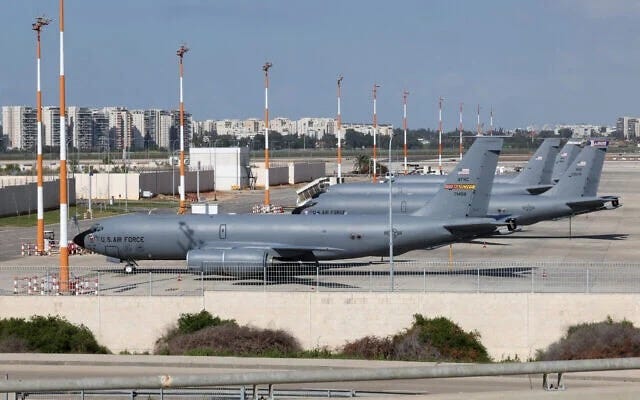
A dispute over parking space at Ben-Gurion Airport could soon affect Israeli travelers. Transportation Minister Miri Regev has reportedly called on Prime Minister Benjamin Netanyahu to relocate dozens of American aerial refueling aircraft currently stationed there. Airport officials say the planes are occupying a significant share of the available parking positions just as airlines are finalizing their summer flight schedules.
The issue is particularly urgent because foreign airlines must soon make decisions regarding their July and August operations. Under Israeli passenger compensation regulations, airlines that cancel flights more than two weeks in advance are generally exempt from paying compensation. Airport authorities fear that if carriers conclude they cannot secure sufficient landing and parking slots, they may cancel large numbers of summer flights before that deadline, potentially affecting millions of passengers during the peak travel season
.
The problem extends beyond aircraft parking. Airport officials argue that the presence of large military refueling aircraft also complicates air traffic management during peak operating hours. While such disruptions are manageable during quieter periods, the summer schedule places much greater pressure on both runway capacity and ground operations. A delay involving even a single large military aircraft can create cascading disruptions affecting dozens of civilian flights.
If the issue is not resolved quickly, the result could be a reduction in available international flights at precisely the time demand is highest. Fewer flights would likely mean higher ticket prices, greater difficulty finding seats, and renewed uncertainty for travelers just as international airlines have begun restoring service to Israel following the recent regional tensions.
The episode illustrates how broader military and geopolitical developments can have immediate consequences for Israel’s civilian transportation system and for the millions of Israelis planning summer travel.
DEFENSE NEWS
OptiDefense
One of the more surprising stories to emerge from Israel’s defense sector this week is not about a major contractor such as Rafael Advanced Defense Systems or Elbit Systems, but about a seven-person startup operating from a hangar surrounded by agricultural fields in the Shfeyla (the lowland region between Jerusalem and the Mediterranean coast). The company, OptiDefense, has spent the last several years developing compact laser systems designed to counter drones and other aerial threats at a fraction of the cost of the large-scale laser systems now entering Israeli service.
The company was originally established in 2019 to address the threat posed by incendiary and explosive balloons launched from Gaza. According to its founders, the system successfully intercepted hundreds of such balloons and demonstrated an ability to engage small drones at relatively short ranges. Their current effort is focused on expanding those capabilities into a dedicated anti-drone system. Unlike many other laser projects, OptiDefense uses a different wavelength that does not pass through glass, making it potentially safer for operation near airports and in urban environments where civilian infrastructure is nearby.
What makes the story noteworthy is the contrast between the scale of the company and the growing urgency of the drone threat. As Israel, Ukraine, and other countries confront increasingly sophisticated unmanned aerial systems, many current solutions remain extremely expensive. The founders argue that protecting long borders, military bases, or civilian infrastructure cannot rely exclusively on laser systems that cost tens of millions of dollars each. Their approach emphasizes lower-cost, deployable systems that could become one layer in a broader defense network alongside electronic warfare, kinetic interceptors, and cyber capabilities.
The company believes it can demonstrate the ability to destroy drones at ranges of approximately one kilometer by early 2027. Its founders contend that limited funding, rather than technological barriers, has slowed development. They argue that had greater investment been available earlier, Israel might already have had an operational low-cost laser drone defense system during both the war in Ukraine and the current regional conflicts. Whether OptiDefense ultimately succeeds remains to be seen, but its work highlights how some of the most innovative efforts to address the drone challenge are coming not from Israel’s defense giants, but from small teams working far from the spotlight.
∞–––∞–––∞–––∞–––∞–––∞–––∞–––∞–––∞–––∞–––∞–––∞–––∞
TODAY IS JEWISH HISTORY
Bialystok Pogrom
The Bialystok pogrom that began on June 14, 1906, stands among the bloodiest assaults on Russian Jewry in the years before the First World War. The city, then a textile center in the western Russian Empire with a Jewish majority and a strong base for the secular, socialist Jewish Labor Bund, had been simmering since the failed 1905 revolution.
For three days, Russian troops and policemen attacked Jewish homes and businesses, spurred by the killing of the local police chief and by the deliberately seeded rumor that Jews intended to bomb a Christian religious procession. At least seventy Jews were killed and ninety seriously wounded.
The precise number of victims remains uncertain. Because the dead and injured were dispersed among hospitals, neighboring towns, and private homes, no definitive count was ever established. Some later accounts placed the death toll as high as eighty-one to eighty-eight, citing the names inscribed on a memorial pillar erected in the city’s Jewish cemetery.
Relief, when it came, was both incomplete and hard-won. On the third day, Russia’s minister of internal affairs ordered tsarist forces to halt the pogrom. An investigation followed. The imperial State Duma held local authorities and government employees responsible for the violence, a rare reckoning in an empire that more often tolerated attacks on Jews.
Yet the Jewish community of Bialystok did not scatter. It buried its dead, rebuilt its institutions, and lived in relative security from 1906 until the upheavals of the First World War, a fragile recovery that testified to the endurance of a population that refused to be driven out.
Trump has failed and will be punished. A BIG MOUTH!!! no balls!!!
1) THE NEWS WE READ FROM NEWS AGENTS ARE SPECULATIONS OF WHAT IS NOT REALLY HAPPENING AT THE TIME THEY ARE PUBLISHED.... 2) HISTORY IS WHAT WE ARE TAUGHT FROM THE WINNER`S SIDE . ETC...